
The Linguistic Life of Hawaiʻi's Ocean Culture
In Hawaiʻi, the ocean is not just a scenic backdrop. It is a pantry, a classroom, and a way of life. The language locals use to talk about the water directly reflects this deep, historical relationship. A rich vocabulary drawn from both ʻōlelo Hawaiʻi (Hawaiian language) and Hawaiʻi Creole English (Pidgin) encodes generations of ecological knowledge and practical survival skills.
At the center of this vocabulary are foundational concepts like holoholo and ʻāina. The word holoholo is a Hawaiian verb meaning to go out for pleasure. Today, locals use it as a catch-all expression for cruising, taking a drive, or heading to the beach with no fixed plan.
In the fishing context, saying you are "going holoholo" is a deliberate understatement. Traditional Hawaiian superstition holds that directly announcing plans to fish brings bad luck. Saying you are "going holoholo" provides a socially accepted way to signal the outing without tempting fate.
ʻĀina translates to land, or more literally, "that which feeds." This word emphasizes a worldview where the land and sea are living entities to be cared for in reciprocity, rather than mere resources to be extracted and consumed.
Roots of the Reef
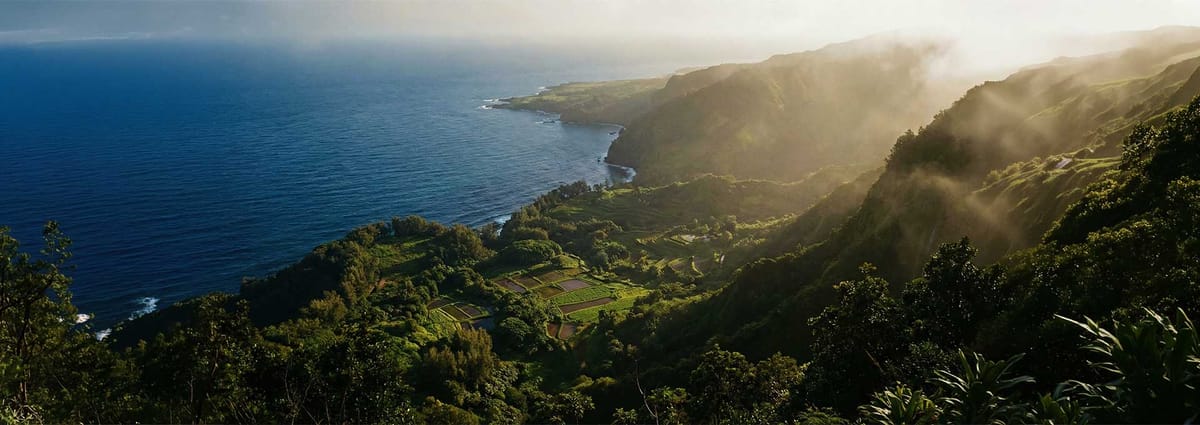
The foundation of Hawaiʻi's ocean vocabulary is built on traditional Hawaiian resource management and the core principle of mālama ʻāina (to care for the land). The traditional ahupuaʻa system divided the islands into wedge-shaped sections running from the mountains (mauka) to the sea (makai). This land division ensured that each community had access to every ecosystem and could manage resources sustainably from the ridge down to the reef.
This management system relied heavily on the kapu (taboo) system and the kaulana mahina (Hawaiian lunar calendar). The konohiki (land agents) enforced specific restrictions to ensure fish populations could replenish during spawning seasons. A key seasonal rotation involved aku (skipjack tuna) and ʻōpelu (mackerel scad), where an open harvest for one meant a strict kapu on the other.
Fishermen would heavily consult the lunar calendar before deciding to cast nets. The calendar's phases dictated everything, noting days beginning with ʻole ("nothing") as unproductive times for fishing. For a deeper look into how these foundational Hawaiian words merged with immigrant languages over time, you can explore the complete history of Pidgin in Hawaiʻi.
Melting Pot on the Shoreline
As immigrants arrived to work on the sugar plantations in the 19th century, the local vocabulary evolved into a functional creole. This linguistic shift mixed Hawaiian, Japanese, Chinese, and English into a seamless, highly specific dialect. You can hear this blending clearly in how locals talk about the reef and their daily catch.
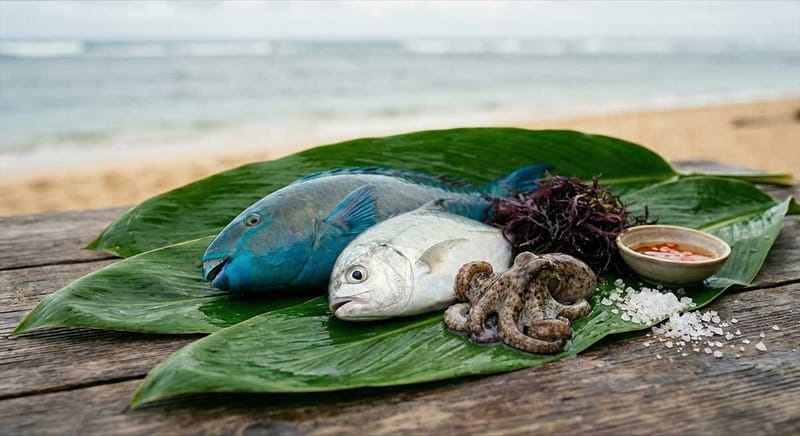
A vivid example of this linguistic layering is the octopus. The Hawaiian word is heʻe, referring to the various reef octopuses found in the islands. However, most locals in modern Hawaiʻi call it tako, a word borrowed entirely from Japanese.
This layered history is also evident in poke. Originally, the word poke simply meant "to slice" or "cut crosswise" in Hawaiian. It was a utilitarian fisherman's preparation of raw reef fish, cut up immediately after the catch and seasoned with sea salt and inamona (roasted kukui nut). Today, the modern poke vocabulary reflects Hawaiʻi's multicultural evolution, incorporating imported ingredients like soy sauce and sesame oil.
The vocabulary for specific fish bypasses broad English terms, using precise names that dominate local conversation:
ʻAhi: Yellowfin tuna. When under 100 pounds, it is commonly called shibi, a Japanese-origin term.
Aku: Skipjack tuna, historically considered one of the most ʻono (delicious) fish.
Ulua: Giant trevally weighing over 10 pounds. Juveniles under 10 pounds are referred to as papio.
Uhu: Parrotfish, a reef dweller often preferred raw and mixed with seaweed.
Manini: Convict tang, a common 3-to-5-inch reef fish that served as a historical staple.
ʻŌʻio: Bonefish, a popular sport and food fish that travels in schools near the reef.
Still Casting Today
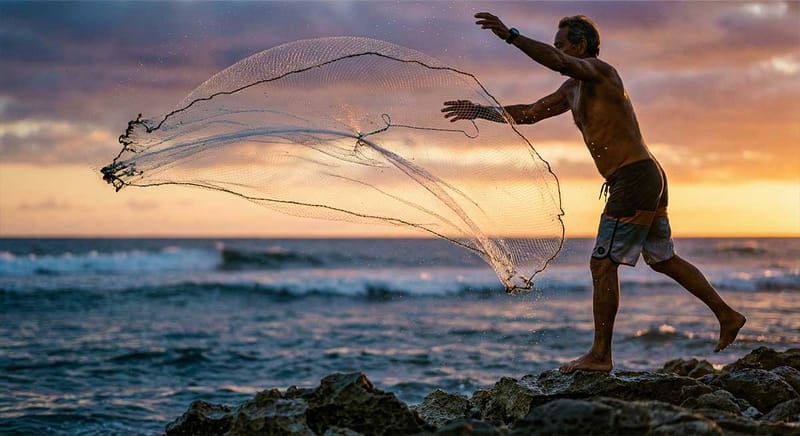
These traditional and borrowed terms are actively used in modern island life. Whether throwing net, casting from the rocks, or freediving, the local vocabulary is the default language of the shoreline. A local fisherman might say they are going to "dunk for papio" without needing to translate the technique or the species.
The terminology of how one fishes and what they gather is highly specific to the island lifestyle. Common practices and intertidal harvests include:
Three-prong: Freediving with a hand-powered spear to hunt tako and reef fish.
Whipping and Dunking: Shoreline casting techniques used to target nearshore species like ʻōʻio.
Hukilau: Community net fishing where a large seine net is pulled to shore, and everyone who assists receives a share of the catch.
ʻOpihi: Endemic limpets prized as a delicacy for family gatherings. They are notoriously dangerous to harvest from wave-battered rocks, earning the dark nickname "the fish of death."
Wana: Spiny sea urchins harvested for their gonads, requiring careful handling to avoid their needle-sharp spines.
Limu: The Hawaiian word for seaweed, encompassing over 600 edible species. Varieties like limu kala are central to cultural forgiveness ceremonies, while limu wāwaeʻiole is frequently foraged for poke.
Preserving the Island Voice
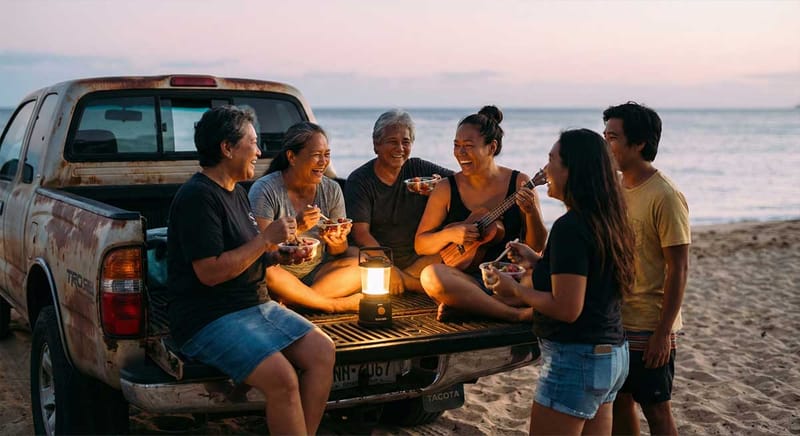
"Going holoholo" describes far more than just a weekend activity. It is the act of stepping outside, engaging with the ʻāina, and actively participating in generational cycles of harvest and reciprocity. The multilingual ocean vocabulary of Hawaiʻi carries the accumulated wisdom and unique identity of island life.
By continuing to use terms like kapu, mālama, and the highly specific names of the reef's inhabitants, locals actively keep this history alive. Maintaining this vocabulary is a practical, everyday way of preserving the local identity. It retains vital ecological knowledge and demonstrates a deep, enduring respect for the environment that sustains the islands.
Original archival photos courtesy of the Library of Congress. Colorized and enhanced.