
How Hawaiian Pidgin Reclaims Space in Modern Street Art
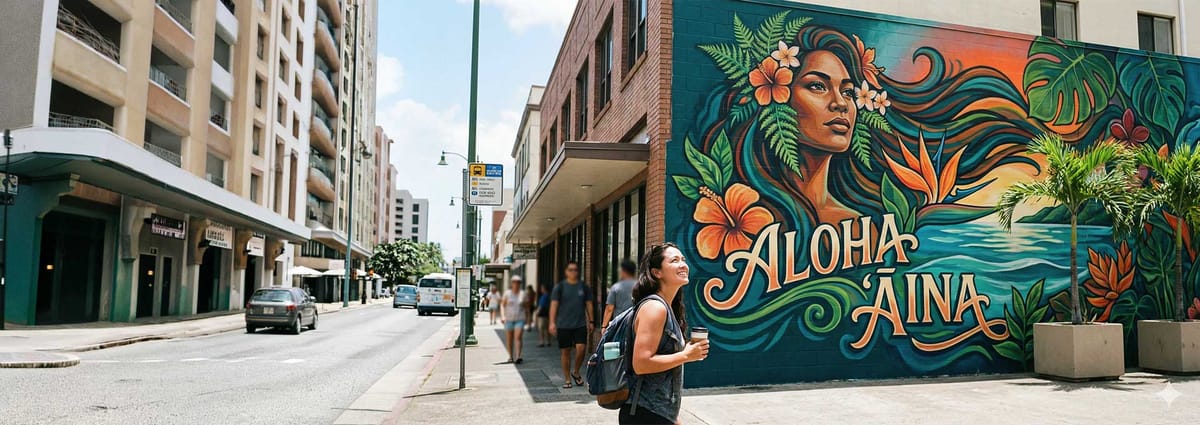
Across Honolulu's rapidly changing neighborhoods, street artists and muralists are using Hawaiian Pidgin (Hawaiʻi Creole English) and ʻōlelo Hawaiʻi as literal tools for public communication. They paint these languages onto buildings to claim physical space, assert local identity, and resist gentrification. From the large-scale murals of Kalihi-Pālama to the commercial walls of Kakaʻako, the combination of local language and public art constitutes a direct form of cultural resistance.
An estimated 600,000 residents of Hawaiʻi speak Hawaiian Pidgin as a first language, with hundreds of thousands more speaking it as a second language. Despite this wide usage, the language has historically faced delegitimization in formal educational and institutional settings. Moving the language from spoken conversation to monumental public art directly challenges this historical stigma.
The Origins of the Language
Hawaiian Pidgin emerged on the sugar plantations in the late 1800s as a functional contact language among immigrant laborers and was officially recognized by the U.S. Census Bureau as a distinct language in 2015. For a complete examination of how this language developed from the plantation era to the present day, read our full guide on Da History of Pidgin in Hawaii.
From Spoken Word to Visual Marker
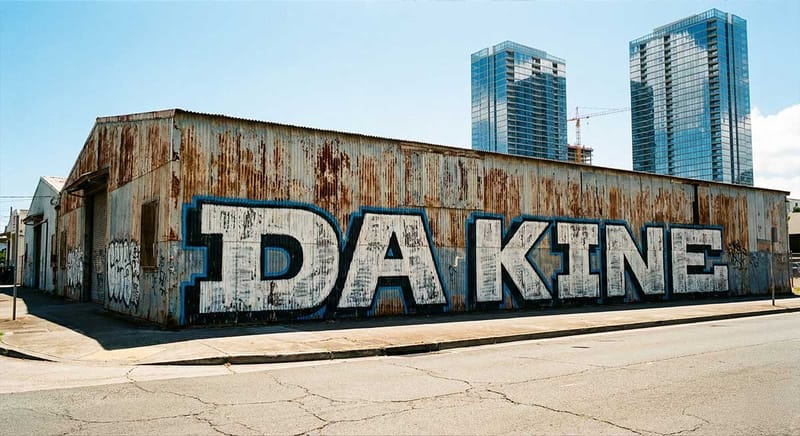
When artists incorporate Pidgin and local slang into street art, they visually mark the territory for the local population. A term like da kine functions as an all-purpose noun, verb, adjective, and adverb that can stand in for virtually anything. When da kine appears on a mural or public sign, it acts as a specific cultural identifier. It is immediately legible to locals and opaque to outsiders, marking the physical space as authentically local.
This visual deployment of language extends beyond single words to include everyday phrases like howzit, pau hana, bumbai, and try wait. Placing these words on public surfaces creates a visual confirmation of belonging for residents who speak the language. It transforms the physical environment into a direct reflection of the community's daily communication.
This practice frequently interacts with the urban development cycle, particularly in areas like Kakaʻako. The district has transformed from an industrial area into a center for luxury condominiums and high-end retail. Developers have utilized the cultural interest generated by street art and murals to market these new properties to outside buyers.
The murals that display local identity often share sidewalks with luxury residential towers where locals cannot afford to live. Out of thousands of housing units built or approved in Kakaʻako since 2005, fewer than eight percent were affordable for low-income households. Unauthorized and community-driven murals serve as a direct response to this commercial redevelopment, offering an uncurated assertion of local presence in a changing landscape.
Artists Visualizing Local Identity
The movement to visualize Pidgin and local identity is led by several key artists, collectives, and initiatives across the islands. They utilize large-scale murals, typography, and illustration to prioritize community representation.
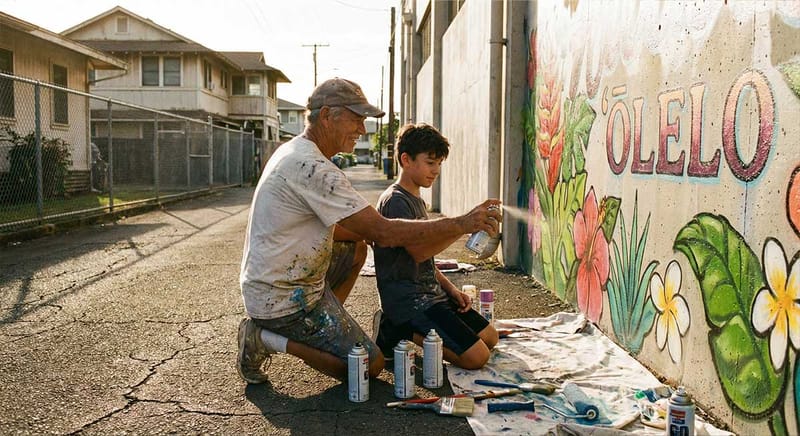
John "Prime" Hina and 808 Urban: Hina is a primary figure in Hawaiʻi's street art scene. He founded the 808 Urban collective, which has produced over 1,000 large-scale murals since 2006. His work directly integrates Hawaiian political identity and moʻolelo (story) into public spaces. He also mentors keiki (children) to carry forward the integration of Hawaiian narrative and street art techniques.
Shar Tuiʻasoa (Punky Aloha): Tuiʻasoa creates bold illustrations of Polynesian women to increase Pasifika representation in gentrifying neighborhoods like Kailua. Her art directly challenges the visual erasure of local identity. She places dark-skinned, full-figured Pasifika women prominently in the visual landscape and regularly collaborates with festivals like Hawaiʻi Walls.
Joe Balaz: Balaz is a writer and visual artist who has spent over 35 years creating poetry in Pidgin. He uses Pidgin typography as a formal aesthetic medium. His visual poetry demonstrates that the written form of the language is a highly developed system capable of sustaining high art.
Kris Goto: Goto is a Honolulu-based pen-and-ink artist and muralist. Her work combines Japanese iconography with Hawaiʻi-specific imagery. She has painted site-specific murals in Kalihi and Pālama, focusing on documenting and depicting the specific histories of the residents in those communities.
Mele Murals: Led by graffiti artist Estria Miyashiro, this statewide initiative engages Hawaiian immersion schools to co-create murals. Students and cultural practitioners embed ʻōlelo noʻeau (Hawaiian proverbs) and mele (song) directly into the artwork. This practice ensures cultural knowledge is documented visually for the next generation.
Hawaiʻi Walls Festival: Originally based in Kakaʻako, this massive mural festival relocated its operations to Kalihi and Pālama starting in 2023. By painting at public schools like Farrington High School instead of developer-owned warehouses, the festival invests directly in underserved communities. This ensures the art remains in community spaces rather than serving as commercial branding for real estate development.
The visual deployment of Pidgin also overlaps heavily with Hawaiʻi's streetwear apparel scene. Brands utilize the graphic T-shirt as a portable format for Pidgin phrases and Hawaiian language slogans. Wearing these garments functions as a mobile form of the same identity assertion that murals perform on walls.
The Lasting Impact on Local Culture
The increasing presence of Hawaiian Pidgin in street art, streetwear, and public visual culture is a deliberate effort to promote the language. Every mural that incorporates Pidgin typography and every printed item that displays da kine asserts linguistic sovereignty. It shifts Pidgin from a stigmatized vernacular to a validated language of public expression.
By moving art out of private institutions and onto public streets, these artists ensure the language remains accessible to the hundreds of thousands of people who speak it daily. The continued visualization of Pidgin guarantees that the local voice remains a highly visible and permanent fixture in Hawaiʻi's urban environment.
Original archival photos courtesy of the Library of Congress. Colorized and enhanced.